Datafying African Agriculture: From Data Governance to Farmers’ Rights
with Barbara Ntambirweki
Development, 2024
This article explores the impact of digital agricultural technologies on African agricultural systems. As we describe, the datafication of African agricultural systems is poised to reshape agrarian power relations significantly. We examine the risks of datafication through a case study of Kenya, a hub for digitalization on the African continent. While Kenya leads in developing data governance policies, the current emphasis on personal privacy overlooks collective risks for smallholder farmers. We advocate for a paradigm shift towards a framework that prioritizes farmers’ rights and fosters participatory data governance, placing farmers at the center of decision-making processes to address underlying power imbalances.

‘Feeding the world, byte by byte’: emergent imaginaries of data productivism
with Maywa Montenegro de Wit
The Journal of Peasant Studies, 2024
Recent scholarship has shed light on how data-driven food systems may entrench productivist and neo-productivist visions of ‘feeding the world.’ In this paper, we examine the narratives and institution-building practices of global development actors, asking: What stories do they tell about how data will transform food systems? Whose ‘data’ are legitimized and whose are overlooked? Our findings point to an emerging imaginary of data productivism—which constructs the making and accumulation of data as a socially intrinsic good. We examine the implications of data productivism for reconfiguring global capitalism, reproducing the modern-colonial order, and inciting social movements to anticipate its hold.
Mobilizing for Farmworker Rights in an Era of Shifting Legal and Governance Opportunities
with Manoj Dias-Abey

Farmworker movements have often been at the forefront of efforts to use the law to achieve social justice. While past generations of farmworker movements in the United States won gains by innovatively using state law and economic tactics to improve their working conditions, farmworkers today face a shifting landscape of law and governance stemming from the development of global value chains. This Article analyzes how contemporary farmworker movements are exploiting both “legal opportunities” and what we term “governance opportunities”— strategic openings for action arising from the contingent industry structures and private governance of global value chains. We analyze two cases of recent farmworker mobilization: Coalition of Immokalee Workers (CIW) in Florida and Familias Unidas por la Justicia (FUJ) in Washington State. By comparing the strategic decisionmaking and processes through which these movements ultimately found success, we show how legal and governance opportunities are interdependent and interactive. Our analysis suggests that the governance opportunities that social movements pursue are highly dependent on the contingent legal contexts in which they operate. Legal opportunities provide important symbolic and constitutive effects for farmworker movements, but as we show, governance opportunities can provide movements with greater leverage and allow them to expand beyond the limited legal protections provided to farm labor. Examining the tactics of farmworker movements—workers that face multiple forms of marginalization— therefore offers significant insights into the strategic opportunities for social change amidst the changing relationship between public and private governance.
The Anthropology of Legal Form: Ethnographic Contributions to the Study of Transnational Law
Law and Social Inquiry, 2023

For most of legal anthropology’s existence as a distinct subfield, ethnographers have studied the function of law rather than its form. With the proliferation of neoliberal technologies of governance, however, anthropologists are increasingly turning to law’s form. This article surveys the anthropology of legal form and its contribution to the study of transnational law and governance. In taking legal form as the object of ethnographic inquiry, legal anthropologists examine the material, sensory, and symbolic dimensions through which law is recognized. Such an approach analyzes how power operates not through law’s substantive meanings but, rather, through its aesthetic dimensions. Current anthropological scholarship has illuminated the diverse ways in which the technical and formal aesthetics of law operate to foreclose political contestation. I argue, however, that the aesthetics of legal form may also be mobilized to render power relations visible and open to challenge amidst proliferating forms of neoliberal governance. Drawing on ethnographic fieldwork within one arena of global governance—the UN Committee on World Food Security—I illustrate how activists draw on the aesthetics of rights to illuminate inequalities and politicize governance processes. In doing so, I suggest that greater engagement with Jacques Rancière’s political theory of aesthetics can deepen anthropological insights into the power of legal form in the context of transnational law and governance.
The ideology of innovation: philanthropy and racial capitalism in global food governance
The Journal of Peasant Studies, 2023

The converging crises of growing food insecurity and climate change have produced a global struggle to govern food systems. While a range of actors promote innovation as a solution to transform food systems, Bill Gates has leveraged his vast philanthropic funding to advocate for a particular vision of technology-driven innovation led by the private sector. This article elaborates Gates’ ‘ideology of innovation’ and analyzes its continuities with an earlier ideology developed to legitimize racial capitalism-improvement. In doing so, it reveals how Gates’ ideology serves to reproduce racialized regimes of ownership and relations of dependence in the information economy.
Translocal legalities: local encounters with transnational law
with Julia Dehm and Marisa Fassi
Transnational Legal Theory, December 2021
Recent scholarship on transnational law has emphasised how the proliferation and fragmentation of normative orders, legal forms, and transnational actors are transforming the nature and authority of law in the contemporary global context. This Introduction presents what we term translocal legalities—emergent forms of normativity that are constituted through grounded encounters with local and transnational legal practices, discourses, subjectivities, and forms of resistance. By coining this new term, we seek to shift the gaze of transnational legal scholarship away from a top-down mapping of the structures of global law. Centring our analysis on the phenomenology of the encounter, we develop an analytical and empirical approach to understanding these encounters by focusing on how law is constituted not solely within traditional legal organisations and institutions, but through the everyday practices, discourses, and subjectivities of those mediating local, national and transnational norms.
Editorial: Resetting Power in Global Food Governance: The UN Food Systems Summit
with with Maywa Montenegro de Wit, Alastair Iles, Molly Anderson, Nora McKeon, Shalmali Guttal, Barbara Gemmill-Herren, Jessica Duncan, Jan Douwe van der Ploeg and Stefano Prato
Development, November 2021
Reconfiguring Food Systems Governance: The UNFSS and the Battle Over Authority and Legitimacy
with Jessica Duncan and Priscilla Claeys
Development, October 2021
The UN Food Systems Summit was an ambitious and hotly contested event that brought competing approaches to global food governance into relief. In this article, we unpack the rival visions that circulate around how food systems should be governed, focusing on two issues that we feel are at the heart of these divergences: authority and legitimacy. We illustrate how both corporate-philanthropic and food sovereignty networks are struggling to establish epistemic authority of food systems as well as produce legitimacy through very different approaches to participation and accountability.
Oxford Handbook of Transnational Law, April 2021
Transnational food law is a growing field of practice that has emerged with the globalization of food and agricultural systems. This chapter analyses the role of food and agriculture as a legally constitutive site of struggle. As both a basic need and an economic commodity, food is an object around which struggles over the organization of markets, the authority of legal institutions, and the regulation of powerful actors have consistently fomented. After surveying the role of agrarian struggles in shaping early international law, this chapter analyses the contentious regulatory space of transnational food security governance. It argues that contemporary governance is shaped by competing paradigms—a ‘productivist’ and ‘food sovereignty’ paradigm—which transnational actors struggle to translate across a variety of regulatory institutions, arenas, and processes. This chapter thereby demonstrates how food and agricultural governance remain a critical space of struggle over the democratic and regulatory possibilities of global governance.
UN Food Systems Summit 2021: Dismantling Democracy and Resetting Corporate Control of Food Systems
with Molly D Anderson and Phil McMichael
Frontiers in Sustainable Food Systems, 2021

This article analyzes the development and organization of the United Nations Food Systems Summit (UNFSS), which is being convened by UN Secretary General António Guterres in late 2021. Although few people will dispute that global food systems need transformation, it has become clear that the Summit is instead an effort by a powerful alliance of multinational corporations, philanthropies, and export-oriented countries to subvert multilateral institutions of food governance and capture the global narrative of “food systems transformation.” This article places the upcoming Summit in the context of previous world food summits and analyzes concerns that have been voiced by many within civil society. It elaborates how the current structure and forms of participant recruitment and public engagement lack basic transparency and accountability, fail to address significant conflicts of interest, and ignore human rights. As the COVID-19 pandemic illuminates the structural vulnerabilities of the neoliberal model of food systems and the consequences of climate change for food production, a high-level commitment to equitable and sustainable food systems is needed now more than ever. However, the authors suggest that the UNFSS instead seems to follow a trajectory in which efforts to govern global food systems in the public interest has been subverted to maintain colonial and corporate forms of control.
Agriculture, Law, and the State
With Amy Cohen and Michael Fakhri
The Routledge Handbook of Law and Society, 2021
This chapter traces how states and other actors have used legal rules and institutions to govern the provisioning of agriculture-based food and to shape national and global power since Second World War. From the 1950s to around the 1980s, governments used law to stabilize and protect domestic markets. From the 1950s until 2008, development planners largely neglected agricultural development. Third World governments and internati
onal institutions alike shifted resources away from agriculture towards industrialization. In the 1980s and 1990s, powerful states, international organizations, and agribusiness corporations used some international institutions to reconfigure agriculture as a question of trade liberalization. In 1986, the United States, the European Community, and other wheat exporting countries began negotiations to include agriculture within formal legal trade agreements that culminated in 1994 with the World Trade Organization Agreement on Agriculture. Food security, the United States argued in these negotiations, is ‘best provided through a smooth-functioning world market’.

Oxford Handbook of Law and Anthropology, 2021
Property regimes refer to the political, legal, and economic systems through which societies order their relationships between people with respect to valued things. Anthropologists and legal scholars have long been engaged in a dynamic dialogue about the organization and practice of property regimes. However, whereas legal theory has been uniquely concerned with ownership and private property as a system for allocating scarce goods and resources, anthropologists have consistently investigated its inconsistencies in everyday practice, illuminating how the distinctions between law and practice mutually constitute power relations. This entry reviews how anthropologists have attended to aporias of property theory by ethnographically analysing conflict and transformations between property regimes. It surveys anthropological insights into three continuing processes of property regime transformation: decolonization, privatization, and enclosure. In addition, it analyses two emergent processes around which property claims are being re-configured: de-materialization and re-materialization. The dematerialization of property through informational and financial capitalism is occurring at a time when industrial modes of carbon-dependent accumulation are facing ecological limits brought on by climate change. However, technologies of informationalization and financialization are also re-materializing property regimes by constructing new calculative devices and global markets for increasingly limited natural resources. How these emerging regimes shape social relations between people, the distribution of social entitlements, and the boundaries between persons and things, offers an important field of ethnographic inquiry.
From Colonialism to Collaboration: Disputing biofuels in the age of the Anthropocene
Max Planck Institute for Social Anthropology Working Paper Series
Biofuels are a major source of conflict in debates over global food and energy security. In the face of climate change, biofuels are being promoted as a new form of “green energy.” However, transnational agrarian movements argue that biofuels exacerbate global food insecurity by lowering global food stocks and increasing global food prices. To manage this conflict, new arenas of multi-stakeholder, collaborative governance have proliferated on multiple political scales. This paper examines the emergence of collaborative governance within the historical context of shifting global arrangements of food and energy production, or what I term “energopolitical regimes.” Drawing on ethnographic fieldwork in the UN Committee on World Food Security, I argue that collaboration is emerging as a contested regulatory ideology in the age of the Anthropocene. As actors engage in collaboration in the face of shifting environmental-human relations, they face new political and ethical dilemmas.
Claiming Food Sovereignty: Legal Mobilization in an Era of Transnational Governance
Studies in Law, Politics and Society, 2020
As social movements engage in transnational legal processes, they have articulated innovative rights claims outside the nation-state frame. This article analyzes emerging practices of legal mobilization in response to global governance through a case study of the ‘right to food sovereignty.’ Developed to oppose to the liberalization of food and agriculture, the claim of food sovereignty is mobilized transnationally by small-scale food producers, food chain workers, and the food insecure. I analyze the formation of this claim in relation to the rise of a ‘network imaginary’ of global governance. By drawing on ethnographic research, I show how activists have internalized this imaginary within their claims and practices of legal mobilization. In doing so, I argue, transnational food sovereignty activists co-constitute global food governance from below. Ultimately, the development of these practices in response to shifting forms of transnational legality reflects the enduring, mutually constitutive relationship between law and social movements on a global scale.
Banana Brokers: Communicative Labor, Translocal Translation, and Transnational Law
Public Culture, 2019
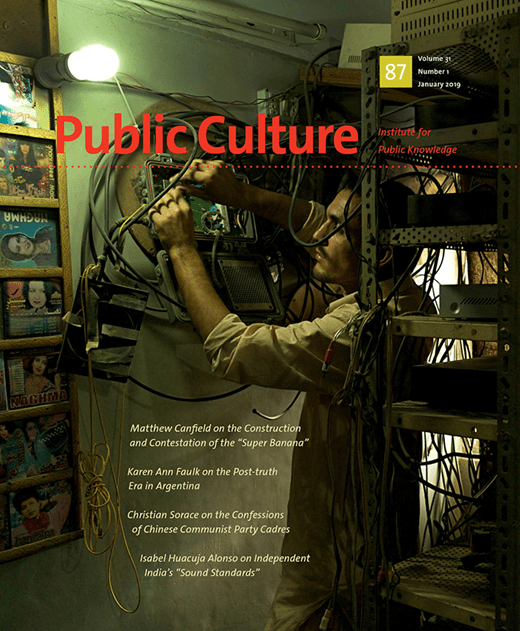
Ethnographers have shown how the fields of human rights and international law are produced by translating norms across political and spatial scales. Neoliberal globalization, however, has transformed the hierarchical imaginary once embedded in the global juridical order. Today, networks of states, international institutions, multi-national corporations, and transnational activists struggle for power by producing competing norms. This essay argues that contemporary transnational legality is produced by networks of actors struggling for interpretive authority through different social practices of translation. I draw on ethnographic fieldwork of the conflict over the “Super Banana—a genetically modified crop funded by the Bill and Melinda Gates Foundation—to analyze how different social practices of translation are constituted. The Super Banana operated as a transnational legal assemblage that produced opposing networks of actors struggling to invest it with meaning. By analyzing the different forms of communicative labor deployed in interpreting the Banana, I show how translocal translation can be distinguished from hegemonic practices of transnational translation by examining translators’ material and symbolic resources, epistemologies, and practices of commensuration. In doing so, this essay illuminates the often-unrecognized differences in communicative labor that constitute competing visions of global legality.
Compromised collaborations: food, fuel, and power in transnational food security governance
Trasnational Legal Theory, 2018

This essay analyses how the relation between food and fuel shapes the practice of collaborative food governance. Dominant explanations for the persistence of global hunger often point to the influence of political-economic inequalities on the production, distribution, and governance of global food. The causes of the 2007–2008 global food crisis, however, suggest the need to examine the entanglements between food and other forms of ecological extraction. I draw on the concept of ‘energopolitics’ to demonstrate how changing material processes of energy extraction condition the calculative logics through which transnational food governance is constituted. An energopolitical analysis, I argue, illuminates how collaborative food governance supresses the conflict between food and fuel that it was developed to mediate. In an era of climate change, such an approach reveals the links between food and broader struggles over carbon-fuelled inequalities
Disputing the Global Land Grab: Claiming Rights and Making Markets Through Collaborative Governance
Law & Society Review, 2018
As transnational movements contest economic inequalities and demand inclusion into global decision-making processes, new models of collaborative governance have proliferated. Promoters of this new mode of governance suggest that it can produce “win-win” solutions through inclusive, consensus- based processes, if these arenas of governance account for power asymme- tries within their rules and processes. Yet, by focusing on procedural aspects of collaboration, these accounts overlook how power operates through the wider landscape of transnational legal pluralism. This article adapts the sociolegal disputing approach to the context of global governance through an extended case analysis of the “global land grab.” In doing so, it demon- strates how power operates through the competition to frame disputes across transnational arenas. I argue that the frame through which collaboration is ultimately deployed serves to reconstitute conflicts, thereby subordinating competing claims to the values of the dominant frame. This analysis ultimately suggests participation in collaborative governance comes with risks. By engaging in collaborative processes, activists face the possibility of constituting the very markets they seek to contest.
Law: Anthropological Aspects (with Sally Merry)
International Encyclopedia of Social & Behavioral Sciences: Second Edition

Anthropologists approach law as a form of normative ordering that includes rules and processes. The anthropology of law has evolved significantly from viewing law as a measure of civilization and savagery to understanding law as an emergent cultural feature and form of power. Contemporary anthropologists investigate law ethnographically, by looking at disputes in spaces that lack formal legal institutions and codified law, as well as in the institutional sites where law is produced. Plural legal orders, each invested with particular modes of authority, are seen as a feature of all societies. With the growth of globalization and transnational law, anthropology has extended its scope to explore the dialectical interaction between these multiscalar forms of law.
 Matthew Canfield