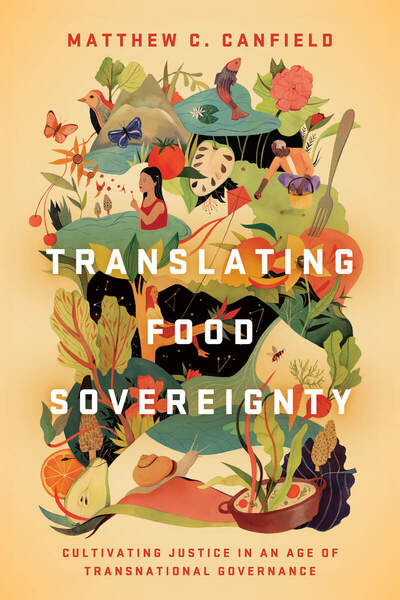
In its current state, the global food system is socially and ecologically unsustainable: nearly two billion people are food insecure, and food systems are the number one contributor to climate change. While agro-industrial production is promoted as the solution to these problems, growing global “food sovereignty” movements are challenging this model by demanding local and democratic control over food systems. Translating Food Sovereignty accompanies activists based in the Pacific Northwest of the United States as they mobilize the claim of food sovereignty across local, regional, and global arenas of governance. In contrast to social movements that frame their claims through the language of human rights, food sovereignty activists are one of the first to have articulated themselves in relation to the neoliberal transnational order of networked governance. While this global regulatory framework emerged to deepen market logics, Matthew C. Canfield reveals how activists are leveraging this order to make more expansive social justice claims. This nuanced, deeply engaged ethnography illustrates how food sovereignty activists are cultivating new forms of transnational governance from the ground up.
Awards
2023 Honorable Mention: APLA Book Prize in Critical Anthropology
Blurbs
“This book brings to life interactions among globally connected activist communities seeking to challenge dominant and rather simplistic ways of thinking about inequality, the environment, poverty, and food production. A must-read for scholars, students, and activists as well as those seeking to implement more inclusive and realistic policies.”
—Eve Darian-Smith, University of California, Irvine
“Matthew Canfield is one of the leading socio-legal scholars focused on food sovereignty and agroecology. In this gripping account of the burgeoning food sovereignty movement in the US, he highlights how activists use food sovereignty to challenge transnational governance and neoliberal economic models. Canfield grounds his work in detailed ethnographical study and tells a bigger story of how struggles over the control of food systems can transform law, society, and economy. The food sovereignty movement is over 25 years old and has used law in complex and creative ways. While at the same time, food politics today are more intense than ever. This book is incredibly timely and provides an account of legality in the food sovereignty movement that we’ve all been waiting for.”
—Michael Fakhri, UN Special Rapporteur to the Right to Food
“Translating Food Sovereignty is as ambitious as it is engaging. Expertly weaving together ethnography with legal studies, Canfield not only helps us to re-imagine more just food systems, he shows us how this is already being done.”
—Jessica Duncan, Wageningen University
Reviews
American Association of Geography Review of Books
Journal of Human Rights and the Environment
Medical Anthropology Quarterly
 Matthew Canfield